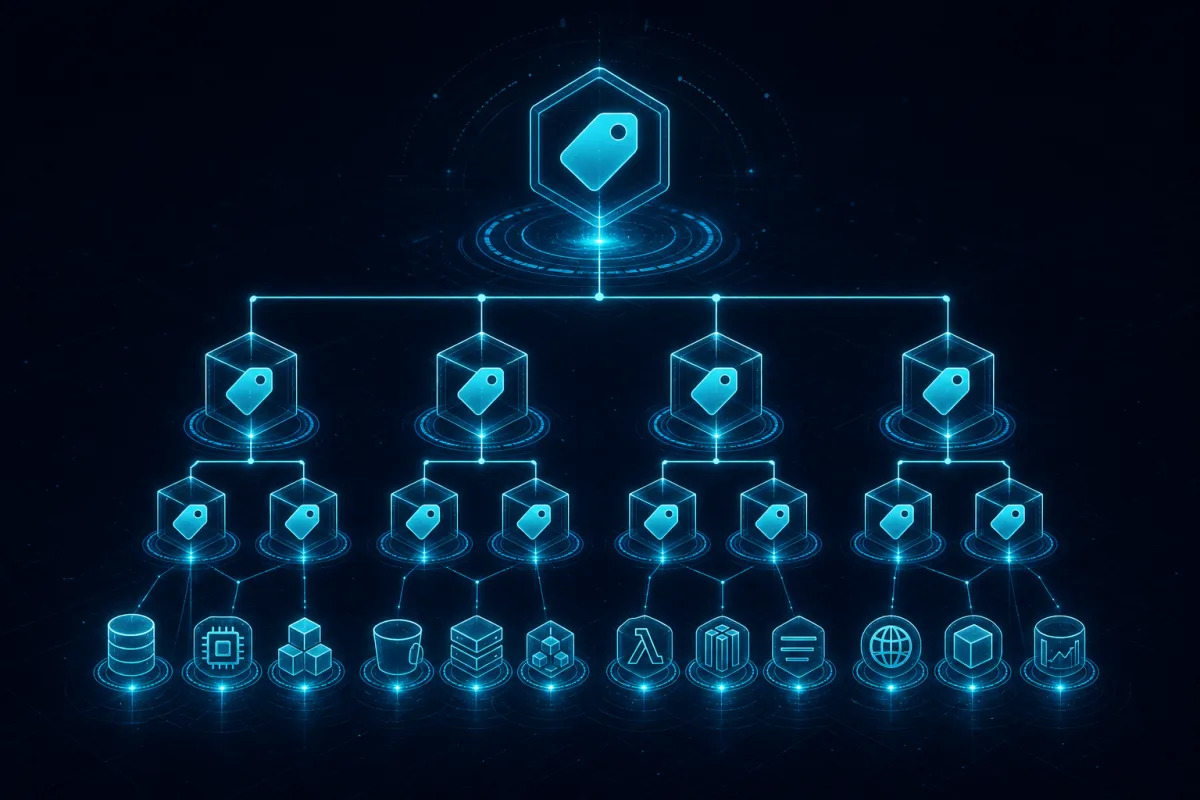
AWS tagging is the prerequisite for every other FinOps practice. Without consistent tags, Cost Explorer filters are meaningless, chargeback reports are guesswork, and anomaly detection fires on noise. A tagging strategy that actually works requires a taxonomy, enforcement, and a feedback loop that keeps the data clean as the environment grows.
Most tagging initiatives fail because they start with a spreadsheet of 40 tags and no enforcement. The result is partial coverage, inconsistent values, and a taxonomy that no one follows after the initial push.
Tag Taxonomy That Survives Growth
The minimal viable set is team, environment, project, and cost-center. These four tags enable the core FinOps questions: which team owns this spend, is it prod or non-prod, which initiative is it funding, and which business unit should be charged.
Add project-specific tags only when the business needs the granularity. A tag for "customer" or "feature-flag" makes sense when you are optimizing per-customer cost or running A/B experiments. It is noise when applied to every EC2 instance.
The values must be controlled. Free-text tags produce "dev", "Dev", "development", and "Development" in the same report. Use a canonical list and enforce it at creation time.
Enforcement: SCPs, AWS Config, and Tag Policies
Service Control Policies can require specific tags on resource creation. The policy fails the API call if the required tags are missing. This is the strongest enforcement but requires careful scoping so that automation and IaC pipelines are not blocked.
AWS Config rules provide detective enforcement. They flag resources that are missing required tags or have invalid values. The findings feed a remediation workflow that either auto-tags or alerts the owner.
Tag policies in AWS Organizations add another layer. They define allowed values for each tag key and can be applied at the account or OU level. The combination of SCPs for prevention and Config for detection covers most gaps.
Chargeback vs Showback
Chargeback allocates actual costs to the consuming teams or business units. Showback reports the spend without moving money. Most organizations start with showback to build trust in the numbers, then move to chargeback once the tagging is reliable.
The chargeback model needs a clear owner for untagged or ambiguously tagged resources. Some teams create a "shared" or "unallocated" cost center that absorbs the orphan spend. The goal is to drive tagging compliance, not to punish teams for legacy resources.
Common Mistakes That Destroy Visibility
Inconsistent values are the most common. "Team: platform" and "Team: Platform Engineering" appear as two teams. The fix is a single source of truth for tag values and validation at creation time.
Missing resources are the second. Auto-scaling groups, spot fleets, and some serverless resources do not inherit tags from the parent. The tagging strategy must include explicit rules for these resource types.
Tag inheritance limitations in AWS are a frequent surprise. Tags applied to an account do not automatically propagate to resources created in that account. The IaC or deployment pipeline must pass the tags through.
Maintaining the Taxonomy Over Time
The taxonomy will need updates. New business units, new project types, and new cost-allocation needs appear. The process for proposing and approving a new tag should be lightweight but visible. A monthly FinOps sync where teams request tag additions keeps the taxonomy current without turning into a free-for-all.
The feedback loop also catches drift. A quarterly audit that samples 100 resources and checks tag accuracy surfaces the gaps before they compound.
Have an AWS environment where tagging is the blocker to real FinOps? Talk to Rutagon or call 907-841-8407. We audit your current tag coverage and design the enforcement layer in the first call.
FAQ
How many tags are too many?
More than 15-20 active tags usually indicates scope creep. The core four (team, env, project, cost-center) plus 3-5 domain-specific tags cover 90% of FinOps needs. Beyond that, the reporting surface becomes fragmented and maintenance cost rises.
Can we retroactively tag existing resources?
Yes, but it requires a one-time remediation pass. AWS Config or a custom script can identify untagged resources and apply the correct tags based on naming conventions, account, or other signals. The remediation should be run once, then enforcement prevents new drift.
What about resources created outside IaC?
Manual resources and resources created by third-party tools are the hardest to tag consistently. The enforcement layer must cover the console, CLI, and any external tools. SCPs and Config rules catch most of these paths.
How do tags interact with AWS Cost Categories?
Cost Categories let you group resources by tag values or other dimensions. They are useful for creating virtual cost centers that do not map 1:1 to AWS accounts. The tagging strategy should anticipate the Cost Category definitions so the two systems reinforce each other.
Who owns the tagging strategy?
FinOps or the cloud platform team owns the taxonomy and enforcement. Each application team owns tagging their own resources correctly. The division of responsibility prevents the platform team from becoming a bottleneck while keeping the taxonomy coherent.
---
*Cross-reference: See Cloud Cost Anomaly Detection: Catch Waste Early for the alerting layer that becomes useful only after tagging is reliable.*