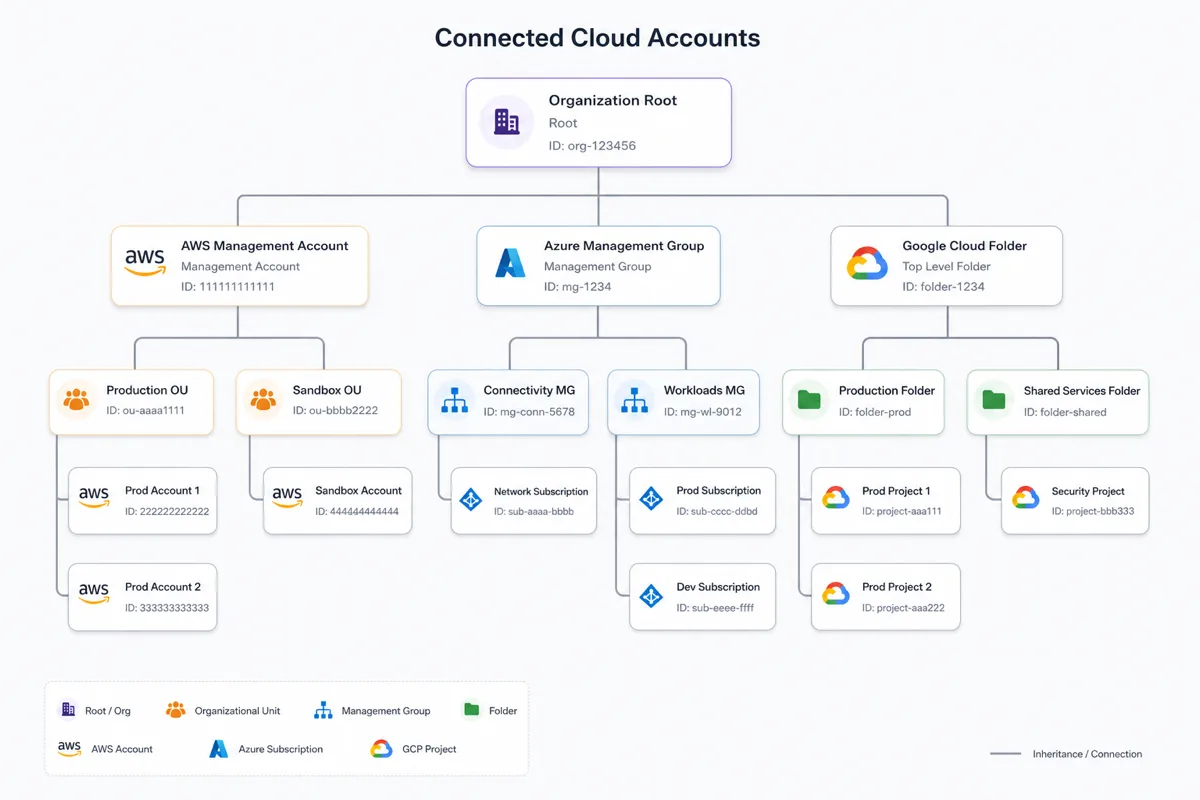
A single AWS account works fine until it doesn't. We consistently see the same pattern with scaling companies: one account holding production, staging, and every developer's sandbox resources, with IAM permissions that have grown organically into an unmanageable mess. AWS Organizations multi-account architecture solves this — but only if the account structure is designed deliberately, not bolted on after a security incident forces the issue.
Why a Single Account Breaks Down
In a single-account setup, a misconfigured IAM policy in a developer sandbox can touch production resources. Billing visibility across environments is muddy. Compliance auditors have a much harder time demonstrating isolation between environments when everything shares one account boundary.
The Account Structure We Recommend
Root Organization
├── Security OU
│   ├── Log Archive Account
│   └── Audit/Security Tooling Account
├── Infrastructure OU
│   └── Shared Services Account (CI/CD, DNS, networking hub)
├── Workloads OU
│   ├── Production Account
│   ├── Staging Account
│   └── Development Account
└── Sandbox OU
    └── Individual developer sandbox accounts
Each account is isolated at the AWS account boundary — the strongest isolation AWS offers, stronger than VPC or IAM boundaries within a single account. A compromised or misconfigured sandbox account cannot directly reach production resources.
Service Control Policies as Guardrails
SCPs applied at the Organizational Unit level enforce non-negotiable boundaries regardless of what IAM permissions an individual account grants:
{
  "Version": "2012-10-17",
  "Statement": [
    {
      "Sid": "DenyRegionsOutsideApproved",
      "Effect": "Deny",
      "NotAction": ["iam:*", "organizations:*", "route53:*", "cloudfront:*"],
      "Resource": "*",
      "Condition": {
        "StringNotEquals": {
          "aws:RequestedRegion": ["us-east-1", "us-west-2"]
        }
      }
    },
    {
      "Sid": "DenyRootUserActions",
      "Effect": "Deny",
      "Action": "*",
      "Resource": "*",
      "Condition": {
        "StringLike": { "aws:PrincipalArn": "arn:aws:iam::*:root" }
      }
    }
  ]
}
This SCP prevents resource creation outside approved regions and blocks root user actions across every account in the OU — protections that hold even if an individual account's IAM configuration is misconfigured.
Centralized Logging Architecture
All accounts stream CloudTrail, VPC Flow Logs, and GuardDuty findings to the dedicated Log Archive account, where an S3 bucket policy denies deletion even by account administrators:
- CloudTrail: organization-wide trail capturing API activity across every member account
- AWS Config: aggregated compliance view across all accounts from a single dashboard
- GuardDuty: delegated administrator account with findings aggregated organization-wide
This gives security teams a single pane of glass instead of chasing logs across a dozen disconnected accounts — a common gap we find during compliance readiness assessments.
Terraform-Managed, Not Console-Clicked
We provision the entire account structure through Terraform using the aws_organizations_account resource and account factory patterns, so every new account — a new developer sandbox, a new environment — comes with baseline SCPs, logging configuration, and networking already attached, rather than starting from a blank, unmanaged state.
Results
For a scaling SaaS client moving from a single sprawling account to this structure, the migration eliminated cross-environment IAM risk entirely and cut their compliance audit prep time significantly, since evidence of environment isolation is now structural rather than something the audit team had to manually demonstrate through IAM policy review.
Ready to talk about your AWS account architecture? Talk to us about your AWS architecture — 907-841-8407 or contact@rutagon.com.
Frequently Asked Questions
How many AWS accounts should a scaling startup have?
There's no fixed number, but a common minimum viable structure includes separate accounts for production, staging/development, shared services (CI/CD, networking), and security/log archive — four to six accounts is typical for a company under 50 engineers.
What's the difference between an SCP and an IAM policy?
An IAM policy grants or denies permissions to a specific user or role within an account. A Service Control Policy (SCP) sets the maximum available permissions for an entire account or Organizational Unit — it acts as a guardrail that IAM policies within that account cannot exceed.
Does a multi-account setup increase AWS costs?
Multi-account setups don't inherently cost more — you pay for the same resources regardless of account structure. Consolidated billing keeps a single payment method across all accounts, and cost allocation actually becomes clearer with account-level cost separation.
How long does it take to migrate from a single account to AWS Organizations?
Timeline depends on how many resources need to move and whether workloads can be re-deployed fresh in new accounts versus migrated in place. Straightforward migrations for a mid-size workload typically take 4-8 weeks.
Does this account structure help with compliance audits?
Yes, significantly. Account-level isolation between production and non-production environments, combined with centralized immutable logging, directly supports the access control and audit trail requirements auditors look for in most major compliance frameworks.