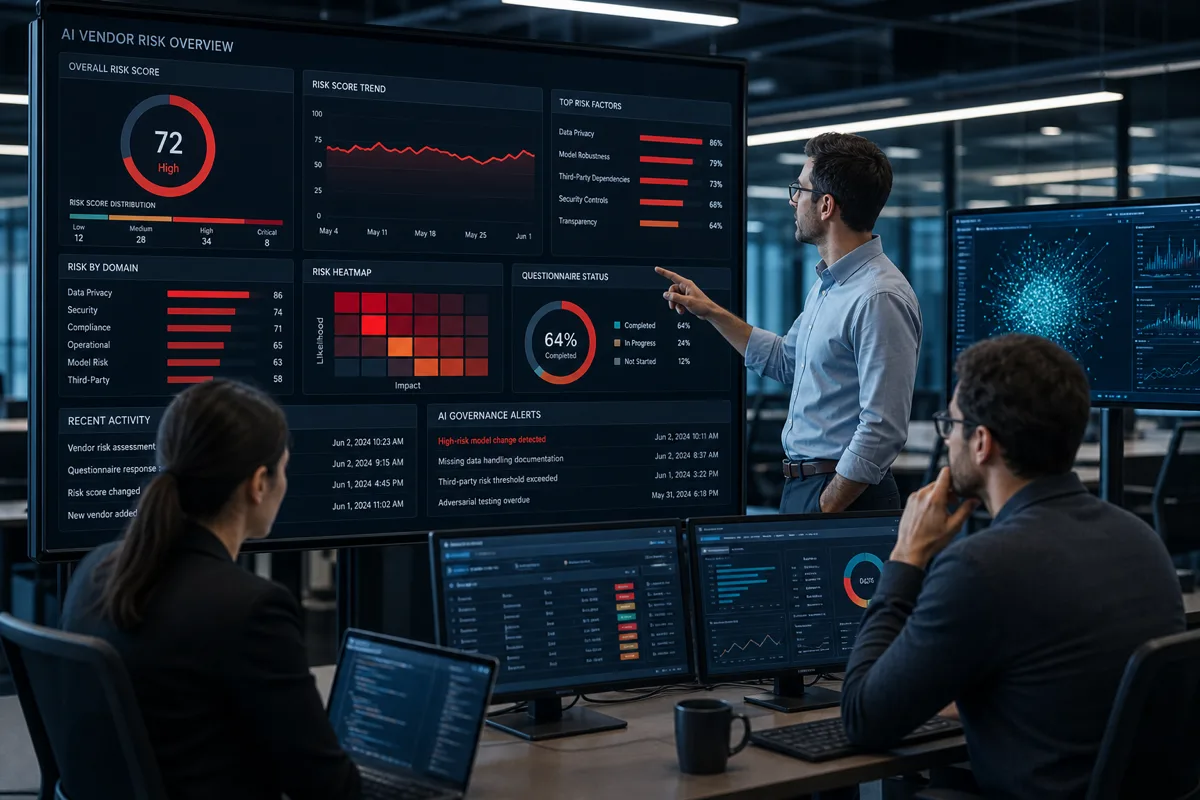
Procurement teams do not lose sleep over missing a trendy AI demo — they lose sleep over a supplier that looks fine on a spreadsheet and later blows up in production, finance, or a customer audit. Manual vendor reviews stack questionnaires, SOC reports, contract clauses, and Slack threads until the queue is weeks deep. That is the pain we designed AI-powered vendor risk assessment to remove: compress evidence intake, score consistently, and leave humans on exceptions that actually matter.
Rutagon builds these systems as production workflow products, not slideware. Below is what we shipped for commercial buyers who needed third-party risk decisions at the pace of their deal cycle — without pretending a model replaces legal or security ownership.
Buyer Pain: Risk Reviews That Cannot Keep Up
Typical mid-market patterns we see before automation:
- Questionnaires live in email PDFs; answers are retyped into a tracker
- Contract PDFs are skimmed by whoever has bandwidth that week
- Continuity signals (breaches, ownership changes, financial distress) arrive late via news or a panicked sales rep
- Scoring is tribal: two reviewers give different ratings for the same packet
- Onboarding is blocked while risk sits in a queue labeled “pending”
The business cost is not only labor hours. Slow vendor approval delays integrations, renewals slip, and shadow IT fills the gap with unvetted SaaS. An AI workflow automation for business approach only works when the output is an auditable decision package — not a chat summary.
What Rutagon Built for AI-Powered Vendor Risk Assessment
We delivered a pipeline with four layers:
- Intake — vendors submit (or procurement uploads) questionnaires, certificates, and contracts into a controlled store
- Extraction — models and rules pull structured fields: controls claimed, data types handled, subprocessors, insurance limits, termination clauses
- Scoring — weighted risk model by data sensitivity, criticality tier, and residual control gaps
- Exception routing — high residual risk or low-confidence extractions go to security/legal; low residual risk auto-advances with a review stamp
Architecture sketch:
Vendor portal / email ingest
        │
        ▼
Object store + metadata DB
        │
        ├── Document classification
        ├── Field extraction (LLM + validators)
        └── External signal enrichment (optional)
                │
                ▼
        Risk engine (rules + model)
                │
                ├── Auto-approve (tier A)
                ├── Conditional (tier B + checklist)
                └── Manual review queue (tier C)
We kept the model off the final “approve vendor” button for high-sensitivity tiers. AI proposes; policy owns the decision. That boundary is what finance and auditors accept.
Extraction Patterns That Survived Production
Naive “summarize this SOC report” prompts fail when the report is 80 pages and reviewers need specific control IDs. We structured extraction around schemas:
from pydantic import BaseModel, Field
from typing import List, Optional

class VendorEvidence(BaseModel):
    vendor_name: str
    data_categories: List[str] = Field(default_factory=list)
    hosts_customer_data: Optional[bool] = None
    subprocessors_named: List[str] = Field(default_factory=list)
    insurance_cyber_limit_usd: Optional[int] = None
    encryption_at_rest_claimed: Optional[bool] = None
    incident_sla_hours: Optional[int] = None
    open_control_gaps: List[str] = Field(default_factory=list)
    confidence: float = 0.0
Validators reject impossible combinations (for example, “hosts PHI” with empty BAAs list) and force human review. Confidence scoring is as important as the fields — low confidence is a feature, not a bug.
For related document automation patterns, see our work on AI invoice document processing automation and agentic workflow design patterns. On the infrastructure side, evidence stores and private networking often land under our security automation and AWS cloud infrastructure capabilities.
Scoring Model: Transparent Weights Beat Magic Scores
Buyers asked for a 0–100 score. We gave them that and a readable breakdown:
| Factor | Example weight | Source |
|---|---|---|
| Data sensitivity | High | Questionnaire + contract |
| Business criticality | High | Internal system map |
| Control coverage | Medium | Extracted attestations |
| Continuity / concentration | Medium | Enrichment + finance inputs |
| Contractual protections | Medium | Clause extraction |
Security leaders can argue with a weight. They cannot argue with a black box. When weights change, we version the policy file and keep prior scores for audit.
Production Lessons
Lesson 1 — Separate “evidence quality” from “vendor risk.” A messy PDF is not the same as a dangerous vendor. Queue UX must show both.
Lesson 2 — Human SLAs matter more than model latency. Cutting extraction from four hours to four minutes is useless if the exception queue still waits five days. We instrumented queue age and ownership.
Lesson 3 — Integration beats portal theater. The win was pushing approved vendors into procurement/SSO provisioning systems with the risk packet attached — not another dashboard nobody opens.
Lesson 4 — Never invent certifications. Models hallucinate “SOC 2 Type II” language. We only accept certification claims when the document type classifier and date fields pass validators — otherwise the claim is unmarked pending human confirmation. We do not claim FedRAMP or similar certifications on behalf of clients or vendors in copy or UI.
Outcomes We Targeted
For the engagements that shipped this pattern, the measurable outcomes procurement cared about were:
- Median intake-to-decision time dropped from multi-week to multi-day for standard tiers
- Reviewer time shifted from retyping PDFs to resolving exceptions
- Every decision carried a reproducible evidence package for audits and renewals
Exact percentages vary by volume and tier mix — we refuse vanity ROI slides without baselines. If you need a baseline-first approach, pair this with how we measure AI workflow automation ROI style outcomes.
When Not to Buy This
Skip AI vendor risk if you have fewer than a handful of new vendors per quarter and one security owner who already keeps a clean tracker. Automation pays when volume, audit pressure, or deal velocity make consistency harder than diligence.
Ready to cut vendor review queues without losing auditability? Talk to Rutagon — contact@rutagon.com or 907-841-8407.
Frequently Asked Questions
What is AI-powered vendor risk assessment in practice?
It is a production workflow that extracts structured evidence from questionnaires, contracts, and attestations, scores residual risk with transparent weights, and routes exceptions to humans. It is not a chatbot that “reads” a SOC report and declares a vendor safe.
Does the model replace security or legal sign-off?
No. For high-sensitivity vendors and low-confidence extractions, humans remain the decision owners. AI accelerates packet assembly and consistency; policy and accountable reviewers own approvals.
How do you prevent hallucinated certifications or controls?
We use schema validators, document-type gates, and “unverified” states for claims that lack matching evidence. Reviewers see confidence and source snippets — not free-form summaries presented as facts.
What systems does this usually integrate with?
Common targets are procurement platforms, identity provisioning, ticketing (Jira/ServiceNow), and object storage for evidence retention. The integration map is defined during discovery so scores land where buyers already work.
How long does a typical implementation take?
A focused MVP that covers intake, extraction, scoring, and one exception queue often lands in weeks when questionnaire templates and tiering rules are already known. Broader ERP/procurement integration and multi-region evidence stores extend the timeline.