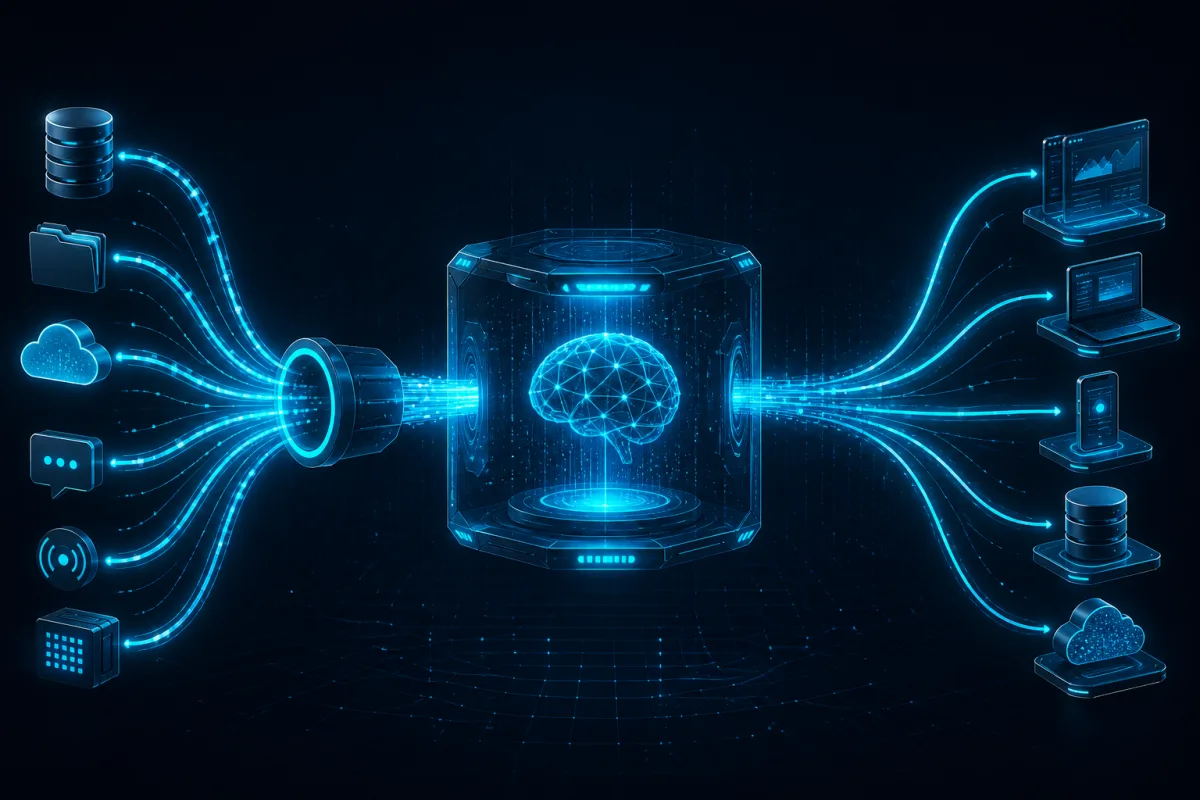
AI-powered data pipelines move beyond traditional ETL. They ingest, enrich with LLM classification and extraction, validate with confidence thresholds, and deliver to warehouses or downstream systems. The architecture below ships and scales.
Ingestion Layer
Accept API webhooks, file drops to S3, and streaming topics (Kinesis, Kafka). Normalize incoming payloads to a common schema. Tag each record with source, timestamp, and ingestion ID. Use dead-letter queues for malformed data.
Enrichment Layer
LLM-based classification, entity extraction, and sentiment at the record level. Route high-value records through Claude 3.5 or GPT-4o. Cache common classifications to control cost. Store model version and prompt hash with each enriched record for auditability.
Validation Layer
Schema checks, confidence thresholds, and business rule validation. Reject records below 0.85 confidence or missing required fields. Route to human review queue when confidence is borderline. Log every rejection reason.
Delivery Layer
Write to data warehouse (Snowflake, BigQuery, Redshift), push to downstream APIs, or update dashboards. Support both batch and near-real-time delivery. Include lineage metadata so consumers know exactly how each field was derived.
Real Pipeline Patterns
Invoice processing: ingest PDF, extract line items with LLM, validate totals, push to ERP. Customer support tickets: classify intent, extract entities, route to correct queue, update CRM. Sensor data: aggregate readings, detect anomalies with LLM, alert operations.
Cost per Record and Failure Handling
Typical cost: $0.002-$0.01 per record depending on LLM usage. Failures are retried with exponential backoff. Permanent failures land in a quarantine bucket with human review workflow. Monitor cost per successful record weekly.
Internal links: see ai data extraction pdf automation and event driven AI automation.
FAQ
How do we control LLM cost at scale?
Cache deterministic classifications, use smaller models for simple tasks, and batch requests. Monitor token usage per pipeline stage.
What happens when the LLM hallucinates?
Validation rules catch most hallucinations. Human review queue catches the rest. Never trust LLM output without validation.
Can we use open source models?
Yes for classification and extraction. Host on SageMaker or Together.ai. Trade some accuracy for cost and data privacy.
How long does it take to productionize a pipeline?
4-8 weeks for a focused pipeline with 2-3 enrichment steps. Add time for data quality rules and human review workflows.
How do we version prompts and models?
Store prompt templates and model versions in git. Tag every enriched record with the exact prompt and model used. This enables reproducible audits.
Have a project that needs this? Talk to Rutagon or call 907-841-8407.
Related: ai contract review automation, ai weekly report automation.