A mid-size SaaS operations team came to us with a familiar problem: every new customer required a human to manually copy data from a signed contract into their CRM, provisioning system, and billing platform — a process that took 45-60 minutes per account and introduced data-entry errors that surfaced weeks later as billing disputes.
This is what AI-powered customer onboarding automation actually looks like when it's built for production, not a demo.
The Problem With the Manual Process
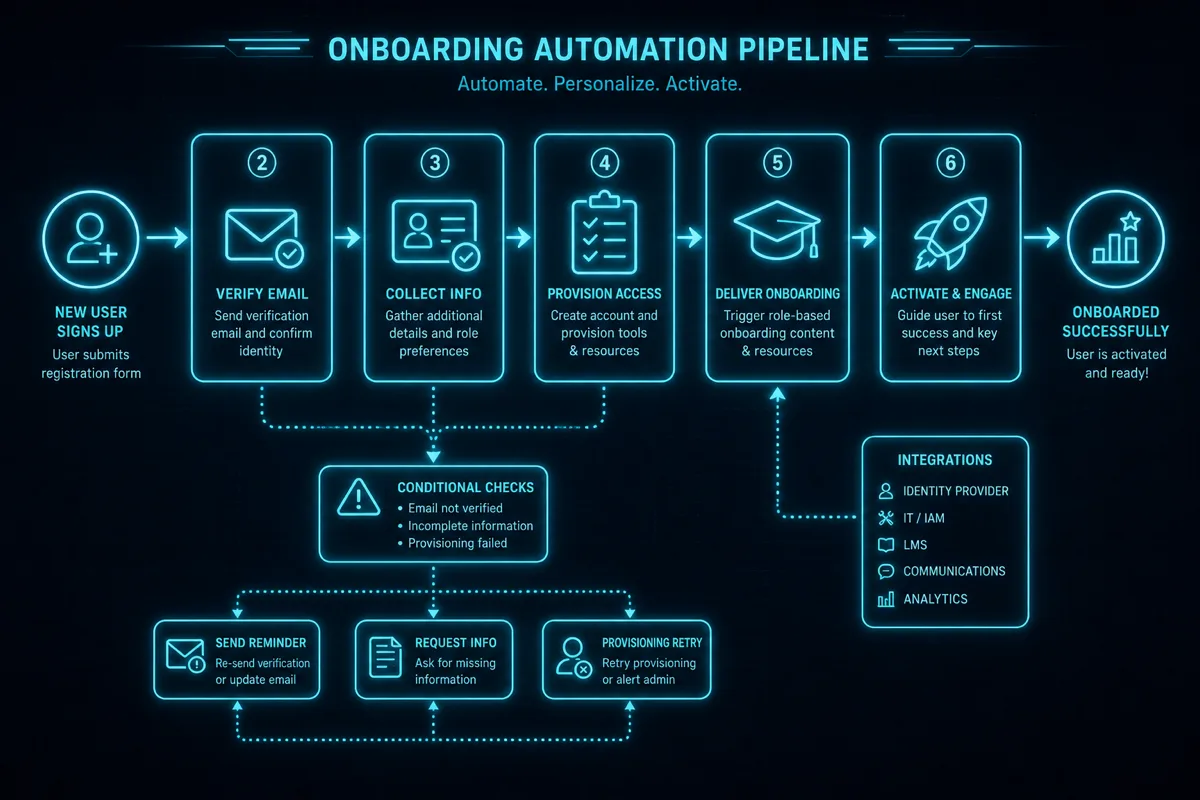
The team's onboarding flow involved six discrete steps: contract review, CRM record creation, provisioning ticket generation, billing account setup, welcome email sequencing, and internal Slack notification. Each step lived in a different tool, and each handoff was a manual copy-paste. Errors compounded — a mistyped account tier in step 2 would silently propagate into billing three steps later.
What We Built
We designed an event-driven pipeline triggered the moment a signed contract lands in the team's document system:
- Document intake — an S3 event triggers a Lambda function when a new signed contract PDF arrives
- Extraction — a Claude model on AWS Bedrock parses the contract, extracting customer name, tier, contract value, billing cadence, and special terms into structured JSON
- Validation — extracted fields are checked against a schema and business rules (e.g., contract value must match one of the approved pricing tiers); anything outside expected bounds routes to a human review queue instead of proceeding automatically
- Fan-out — validated data is written to the CRM via API, a provisioning ticket is created, and a billing account is initialized — all in parallel via separate queue consumers
- Notification — a Slack message summarizes the new account and flags anything that required manual review
def extract_contract_fields(document_text: str) -> dict:
    response = bedrock_client.invoke_model(
        modelId="anthropic.claude-3-5-sonnet-20241022-v2:0",
        body=json.dumps({
            "anthropic_version": "bedrock-2023-05-31",
            "max_tokens": 1024,
            "messages": [{
                "role": "user",
                "content": f"Extract customer_name, tier, contract_value, "
                            f"billing_cadence, and special_terms as JSON "
                            f"from this contract:\n\n{document_text}"
            }]
        })
    )
    return validate_schema(json.loads(response["body"].read()))
Why Event-Driven, Not a Scheduled Batch Job
A nightly batch job would have added up to 24 hours of latency between contract signature and a customer's first login — unacceptable for a business trying to reduce time-to-value. The event-driven design (S3 → EventBridge → Lambda → SQS fan-out) processes most contracts in under two minutes end to end.
The Validation Layer Is the Real Engineering Work
Anyone can wire an LLM to an API. The actual production challenge is deciding what happens when extraction is ambiguous or wrong. We built a confidence-scoring layer: if the model's extracted contract value doesn't match one of the client's known pricing tiers, or if key fields come back empty, the record routes to a human review queue instead of silently creating a bad account. This is the difference between an automation that works in a demo and one that survives contact with messy real-world contracts.
Results
The client went from a 45-60 minute manual process with periodic downstream errors to a sub-2-minute automated pipeline with roughly 90% of contracts requiring zero human touch. The remaining ~10% route cleanly to a review queue instead of silently corrupting downstream systems — the validation layer paid for itself in the first month by catching several contracts with non-standard terms that would have caused billing errors.
What This Pattern Generalizes To
The same architecture — document intake, LLM extraction, schema validation, fan-out to downstream systems — applies to invoice processing, insurance claims intake, HR onboarding, and any workflow where structured data currently gets manually transcribed from unstructured documents.
If your team is copying data between systems by hand, talk to us about your automation project — call 907-841-8407 or email contact@rutagon.com.
Frequently Asked Questions
How long does it take to build a custom AI onboarding automation like this?
For a well-scoped single-workflow automation like contract-to-CRM onboarding, initial builds typically run 3-6 weeks depending on the number of downstream systems and how much validation logic the business rules require.
What happens when the AI extracts something wrong?
Production-grade pipelines include a confidence-scoring and validation layer that routes ambiguous or out-of-bounds extractions to a human review queue rather than letting bad data flow downstream automatically. This is the most commonly skipped step in DIY automation attempts.
Does this require AWS specifically, or can it run on other clouds?
The pattern — event trigger, LLM extraction, schema validation, fan-out to APIs — is cloud-agnostic. We build it on AWS Bedrock most often, but the same architecture ports to Azure OpenAI Service or Google Vertex AI with minimal changes to the invocation layer.
How do you handle contracts with unusual or non-standard terms?
Non-standard terms are exactly the case the validation layer is designed to catch. Any field that falls outside expected pricing tiers, dates, or formats routes to human review instead of being silently accepted.
Can this integrate with our existing CRM and billing tools?
Yes. Most CRM (Salesforce, HubSpot) and billing (Stripe, Chargebee) platforms expose APIs that the fan-out layer can call directly. Integration complexity depends on how much custom logic your specific tools require.