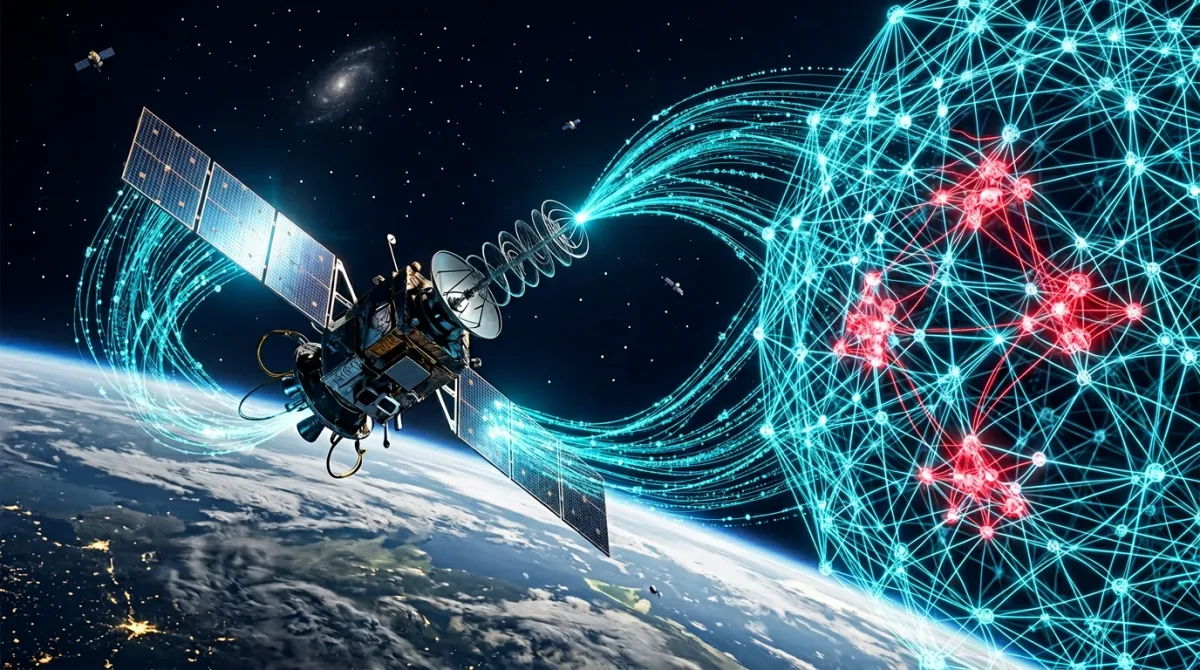
A satellite doesn’t call in sick before it fails. By the time a ground operator sees a flatline on a telemetry channel, the failure has already happened — and in orbit, failures are permanent.
Traditional threshold-based alerts fire when a value crosses a predefined boundary: battery voltage drops below 28V, reaction wheel speed exceeds 6,000 RPM, thermal sensor reads above 85°C. The alert tells you something broke. It doesn’t tell you something is about to break.
We build AI anomaly detection systems that catch degradation patterns weeks or months before they become mission-ending failures. The difference between threshold monitoring and ML-driven anomaly detection is the difference between reading a death certificate and diagnosing a treatable condition.
Why Threshold Monitoring Fails in Space
Space telemetry is high-dimensional, time-dependent, and context-sensitive. A single satellite might transmit thousands of telemetry parameters — voltages, currents, temperatures, angular rates, signal strengths, memory utilization, command counters — every few seconds. The relationships between these parameters shift with orbital position, solar exposure, operational mode, and age.
Threshold monitoring treats each parameter independently. Battery voltage has a floor and ceiling. Temperature has a floor and ceiling. If a value stays within bounds, it’s “nominal.” This approach has three fundamental problems.
Subtle cross-parameter correlations go undetected. A 2% drop in solar array current that coincides with a 1.5% rise in battery charge temperature isn’t alarming in isolation — both values remain within nominal bounds. But the combination indicates accelerated cell degradation that will cause a battery failure in 4-6 months. Threshold monitors never see this pattern because they evaluate parameters independently.
Context-dependent behavior creates false alarms. A reaction wheel drawing 15W during a slew maneuver is normal. The same wheel drawing 15W during a quiescent attitude hold is a sign of bearing degradation. Threshold monitoring can’t distinguish between these contexts without manual rule creation for every operational mode, orbital phase, and seasonal variation — an engineering effort that scales exponentially with satellite complexity.
Slow degradation trends hide within noise. A thermal sensor drifting 0.1°C per month is invisible in daily telemetry plots. The value looks normal today, normal next week, normal next month. Twelve months later, the component is operating 1.2°C above its design baseline, and the remaining margin to failure is gone. Threshold monitoring waits for the breach; ML-based trend detection identifies the drift months earlier.
How We Approach Space Anomaly Detection
Our architecture operates across three layers: telemetry ingestion, model inference, and operational integration — each built for the realities of intermittent ground contact windows, high data volumes during passes, and the requirement that no anomaly goes undetected during communication gaps.
Telemetry Ingestion Layer
Satellite telemetry arrives in bursts during ground station passes. A LEO satellite might have 6-8 contact windows per day, each lasting 8-12 minutes. During each pass, the ground system downloads housekeeping telemetry, payload data, and stored event logs accumulated since the last contact.
We architect the ingestion layer to handle this bursty pattern using event-driven, serverless infrastructure. Telemetry frames arrive through ground station interfaces, get parsed and normalized into a unified time-series schema — regardless of CCSDS packet structures, proprietary manufacturer formats, or varying sample rates — and land in a streaming pipeline for immediate processing. The architecture scales automatically during pass windows and costs nothing between passes.
We’ve documented related ingestion patterns in our work on satellite data processing with AI.
Model Inference Layer
The core is a set of ML models trained on historical nominal telemetry. The models learn what “normal” looks like for a specific satellite in a specific operational context — dynamic behavioral patterns that shift with orbital mechanics, solar conditions, and mission phase.
Autoencoder networks form the primary detection mechanism. Trained on months of nominal telemetry, the autoencoder learns to reconstruct normal telemetry patterns from compressed representations. When live telemetry deviates from learned patterns, reconstruction error increases — even when individual parameters remain within threshold bounds. The magnitude and persistence of reconstruction error maps directly to anomaly severity.
Temporal models using LSTM and transformer architectures capture time-dependent patterns that autoencoders miss. A reaction wheel whose speed oscillations are increasing in frequency over weeks, a solar array whose peak power is declining slightly with each orbital cycle, a thermal subsystem whose response time to eclipse transitions is lengthening — these temporal degradation signatures are exactly what recurrent models excel at detecting.
Contextual classifiers prevent false alarms by incorporating orbital position (via TLE propagation), solar angle, eclipse state, commanded mode, and maneuver history as conditioning inputs. A power draw that would be anomalous during quiescent operations gets correctly classified as nominal during a planned thruster firing. The architecture runs inference in near-real-time during ground contacts and in batch mode between passes.
Operational Integration Layer
Detection without action is just sophisticated logging. The operational integration layer translates model outputs into actionable intelligence for ground operators and mission planners.
Anomaly scoring and classification. Raw model outputs are calibrated into standardized severity levels: NOMINAL, WATCH, WARNING, CRITICAL. A reconstruction error of 2.3σ on solar array parameters might be WATCH, while 4.1σ on a reaction wheel parameter is WARNING. The calibration maps model outputs to operationally meaningful thresholds using historical data.
Trend analysis and prognostics. The system tracks anomaly score trends over days and weeks. A subsystem whose scores are slowly increasing — even if individual readings remain below WARNING — gets flagged for engineering review. This is where the real value lives: catching gradual degradation before it becomes urgent.
Dashboard and alert integration. Outputs feed into real-time data dashboards showing health status, anomaly histories, and predicted time-to-threshold. Alerts route to the appropriate response team — thermal anomalies to the thermal engineer, attitude control CRITICAL alerts to the on-call operator — integrating with existing ground system workflows.
Architecture Decisions and Trade-offs
Building anomaly detection for space systems involves trade-offs that don’t exist in terrestrial ML applications.
Model Training: Supervised vs. Unsupervised
Space anomaly detection is fundamentally an unsupervised problem. Satellites don’t fail often enough to generate labeled training data for supervised classification. We train on nominal data and detect deviations — catching novel failure modes no engineer anticipated.
The trade-off: unsupervised models generate more false positives. We mitigate this with contextual conditioning (reducing mode-change false alarms) and persistence filtering (a single anomalous reading is noise; three consecutive readings during a pass warrant attention).
Edge vs. Cloud Processing
For constellations with onboard processing capability, running lightweight models on the spacecraft enables immediate response without waiting for ground contact. But onboard hardware is radiation-hardened, power-constrained, and generations behind terrestrial compute.
Our architecture supports both: lightweight quantized models for onboard screening and full-fidelity models on the ground for deep analysis. Onboard models flag parameters for priority downlink; ground models perform the comprehensive analysis.
Single-Satellite vs. Fleet Models
We build both single-satellite and fleet models. Single-satellite models capture individual vehicle behavioral patterns with high sensitivity. Fleet models — trained across multiple satellites of the same bus type — detect when one vehicle diverges from its siblings: “Satellite 7 is nominal in isolation, but its reaction wheel power draw is 12% higher than the fleet average.” Both perspectives matter for constellation operators.
Ground Station Integration
Anomaly detection doesn’t operate in isolation — it integrates into the broader ground system architecture that manages satellite operations. Our approach connects anomaly detection outputs with ground systems for satellite operations to create a unified operational picture.
The integration points include:
- Pass planning — anomaly-flagged satellites get extended contact windows for additional diagnostic telemetry collection
- Command authorization — operations commands to anomaly-flagged subsystems require engineering review before execution
- Constellation management — for multi-orbit constellation software, anomaly status factors into task scheduling and redundancy allocation across the constellation
- Reporting — automated anomaly summary reports feed mission readiness reviews and fleet health assessments
Why Alaska Matters for Space Operations
Alaska’s high-latitude geography provides natural advantages for satellite ground operations. Polar and sun-synchronous orbit satellites — the orbits used by most Earth observation, weather, and reconnaissance systems — have more frequent and longer contact windows over Alaska than over lower-latitude ground stations.
We operate from Alaska with direct understanding of these operational advantages. Our space & aerospace capabilities and AI & machine learning capabilities are built for the space operations environment — not adapted from commercial ML platforms that don’t understand orbital mechanics, ground station constraints, or mission-critical reliability requirements.
Frequently Asked Questions
How does AI anomaly detection differ from traditional satellite health monitoring?
Traditional monitoring compares individual telemetry parameters against static thresholds — fixed upper and lower bounds set during spacecraft commissioning. AI anomaly detection learns the dynamic relationships between hundreds of parameters simultaneously, detecting subtle cross-parameter correlations and gradual degradation trends that threshold monitoring misses entirely. The practical difference is detection lead time: AI-based systems typically identify degradation patterns weeks to months before a threshold breach would trigger an alert.
What types of satellite failures can ML models predict?
ML models are most effective at detecting slow-onset failures driven by mechanical wear, thermal cycling fatigue, and component degradation — reaction wheel bearing wear, battery cell capacity loss, solar array efficiency decline, and thermal control degradation. Sudden failures caused by radiation single-event upsets or micrometeorite impacts are inherently unpredictable, but the models can detect secondary effects on subsystems affected by the event within the next telemetry pass.
How much historical telemetry is needed to train an effective anomaly detection model?
For a new satellite, we typically need 3-6 months of nominal telemetry covering a full range of operational modes, orbital conditions, and seasonal variations. For constellation satellites with common bus designs, transfer learning from existing fleet models significantly reduces this ramp-up period — a new satellite can benefit from fleet-trained models within days of commissioning, with per-vehicle refinement improving over the following weeks.
Can anomaly detection systems operate within FedRAMP-authorized cloud environments?
Yes. The inference pipeline runs on standard cloud services — containerized model serving, managed streaming ingestion, and time-series databases — all available within AWS GovCloud and Azure Government. The architecture uses no external API calls or third-party ML services that would complicate the authorization boundary. All model training and inference occurs within the accredited environment.
How does this integrate with existing ground station software?
The anomaly detection system integrates through standard interfaces — REST APIs for real-time anomaly queries, webhook notifications for alert routing, and structured data feeds for dashboard integration. It operates alongside existing ground station software as an analytical overlay rather than a replacement. Ground operators continue using their primary mission systems; the anomaly detection layer adds predictive intelligence that informs their decisions without disrupting established workflows.
Discuss your project with Rutagon
Contact Us →